
HS Football Speed: Average 40-Yard Dash Times by Position
The 40-yard dash stands as a cornerstone of football talent evaluation, offering a glimpse into a player’s raw speed and explosiveness. You might wonder how your own times stack up against the competition or what coaches are looking for when they clock athletes sprinting down the field.

Average High School Football 40 Yard Dash Times by Position: Unveiling the Speed Secrets of Gridiron Glory
The average 40-yard dash time for high school football players typically ranges from 4.8 to 5.2 seconds, though this can vary significantly by position. As you dive into the world of football metrics, understanding these benchmarks can help you gauge your own performance and set realistic goals for improvement. Whether you’re a burner aiming to light up the stopwatch or a lineman focused on quick burst off the line, your 40 time can play a crucial role in shaping your football future.
You can see the average 40-yard dash times for high school, college, and professional football players with these links.
1) Quarterback: 4.7s

As a quarterback, you’re expected to be quick on your feet. The average 40-yard dash time for high school QBs hovers around 4.7 seconds. This speed can make or break your ability to evade defenders and extend plays.
You might wonder how you stack up. Well, elite female high school sprinters can hit times around 4.7 to 5.0 seconds. That puts you in good company if you’re hitting that 4.7 mark.
But don’t get too caught up in the numbers. Remember, your throwing arm and decision-making skills are just as crucial. A slightly slower 40 time doesn’t spell doom for your football dreams.
Keep in mind, hand-timed methods can be up to 0.42 seconds faster than electronic timing. So take those blazing fast times you hear in the locker room with a grain of salt.
Your 40-yard dash is just one piece of the puzzle. Focus on improving your overall athleticism, and you’ll see your times drop. Every tenth of a second counts when you’re trying to outrun that blitzing linebacker.
2) Wide Receiver: 4.5s

You’ll find that wide receivers are among the speediest players on the gridiron. Their average 40-yard dash time hovers around 4.4 to 4.8 seconds at the high school level.
A 4.5-second 40-yard dash is considered excellent for a high school wide receiver. It shows you’ve got the breakaway speed to leave defenders in your dust. This time puts you in the upper echelon of high school talent.
Remember, your 40 time isn’t just about straight-line speed. It’s a testament to your explosive power off the line and your ability to accelerate quickly. These skills are crucial when you’re trying to create separation from cornerbacks.
Don’t be discouraged if you’re not hitting 4.5 seconds yet. With dedicated training and proper technique, you can shave precious tenths of a second off your time. Focus on your start and drive phase to see significant improvements.
Keep in mind that hand-timed 40s can be up to 0.31 seconds faster than electronic times. So, take unofficial times with a grain of salt and always strive for improvement.
3) Running Back: 4.6s

When you’re scouting running backs, speed is the name of the game. A 4.6-second 40-yard dash time for a high school running back is nothing to sneeze at. It’s a solid benchmark that puts you in contention for the varsity squad and catches the eye of college recruiters.
Picture yourself exploding off the line, cleats digging into the turf. You’re a blur of motion, covering 40 yards in less time than it takes to tie your shoelaces. That’s the power of a 4.6 dash.
But don’t get caught up in the hype of inflated times. Many high school athletes claim faster times than they actually run. A legitimate 4.6 is plenty quick enough to make waves on the gridiron.
Remember, raw speed isn’t everything. Your ability to cut, juke, and read the field is just as crucial. A slightly slower back with great vision can outperform a speedster who runs in straight lines.
Train hard, focus on your technique, and aim to shave off those precious tenths of a second. With dedication, you might just see your name in lights on Friday nights.
4) Cornerback: 4.5s
As a cornerback, you’re expected to be one of the fastest players on the field. A 4.5-second 40-yard dash time is impressive for a high school athlete in this position. You need that speed to keep up with wide receivers and make crucial plays.
At this level, you’re showing potential that could catch the eye of college scouts. Your quickness off the line and ability to accelerate quickly are key assets. Remember, though, that raw speed isn’t everything in this position.
Your agility and change of direction skills are just as important as straight-line speed. While a 4.5-second 40-yard dash is faster than many pro football players, you’ll need to work on your technique and football IQ to truly excel.
Keep pushing yourself in training. Your dedication to improving your speed could open doors to playing at higher levels. Every fraction of a second you shave off your time could make a big difference in your football career.
5) Safety: 4.6s
You’ve got to admire the speed and agility of high school safeties. With an average 40-yard dash time of 4.6 seconds, these young athletes showcase impressive quickness on the gridiron.
Picture yourself on the field, watching a safety explode from their stance. In a blink, they’re covering half the field. That 4.6-second dash can mean the difference between a game-saving tackle and a touchdown slipping through your team’s fingers.
Remember, this time isn’t just about straight-line speed. It’s a testament to a safety’s ability to react quickly and change direction. You’ll see them backpedaling, shifting laterally, and bursting forward to make plays all over the field.
Keep in mind, these times can vary. Some exceptional high school safeties might clock in even faster, while others may be a tick slower. But that 4.6-second mark gives you a solid benchmark to gauge talent at this crucial defensive position.
6) Linebacker: 4.8s
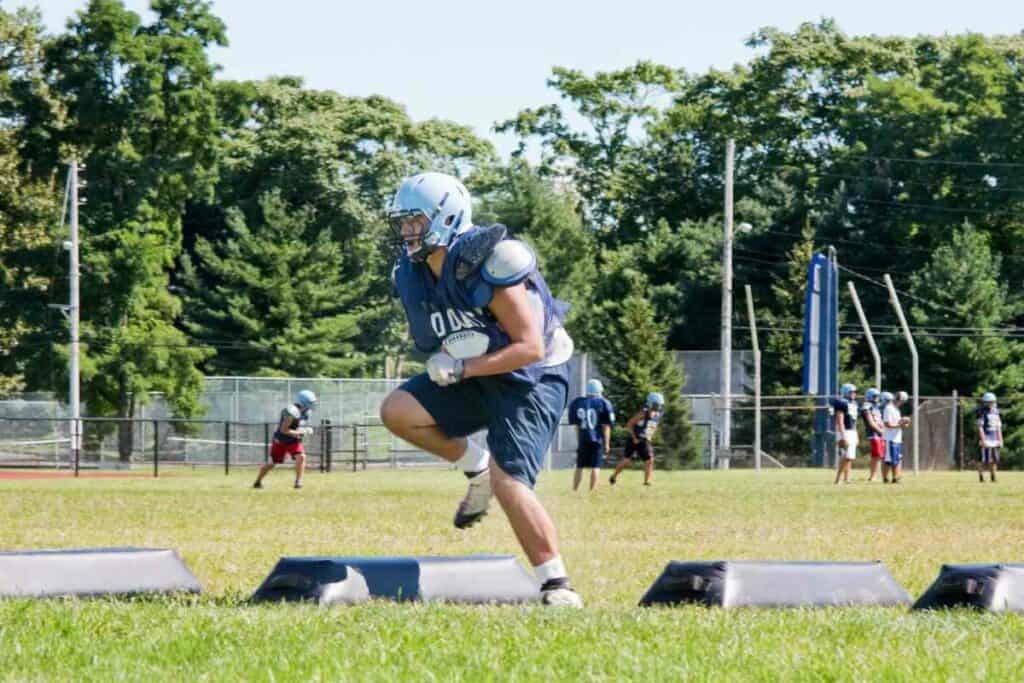
You’ll find linebackers clocking in at an average of 4.8 seconds in the 40-yard dash. This time reflects the unique balance of speed and power these defensive playmakers need on the gridiron. As you watch these athletes burst off the line, you’re witnessing a blend of explosive strength and quick reflexes.
Picture yourself on the sidelines as a linebacker sprints past. In just 4.8 seconds, they’ve covered nearly half the field. It’s a testament to the hours of training these young athletes put in, pushing their bodies to the limit.
You might wonder how this speed translates on the field. Well, it’s the difference between making that crucial tackle or letting a running back slip by. Every tenth of a second counts when you’re chasing down a quarterback or dropping back into pass coverage.
Remember, 4.8 seconds is just an average. Some linebackers might be a touch slower, compensating with raw power and football IQ. Others might surprise you, blazing down the field even faster. It’s this variety that makes the position so exciting to watch and analyze.
7) Tight End: 4.7s

As a tight end, you’re expected to be a versatile player on the field. Your 4.7-second 40-yard dash time reflects this dual role. You need to be quick enough to run routes and catch passes, yet strong enough to block defensive players.
A 4.7-second time is impressive for a tight end. It shows you have the speed to create mismatches against linebackers and safeties. This quickness allows you to stretch the field and be a threat in the passing game.
Your speed also helps in blocking. You can quickly get to your assigned defender and engage them before they react. This agility is crucial for both run blocking and pass protection.
Remember, your 40 time is just one aspect of your game. Coaches also look at your route-running, hands, and blocking ability. But your speed gives you a solid foundation to build on as you develop your skills.
Keep working on your explosiveness and acceleration. These qualities will help you maintain your edge on the field. Your 4.7-second time puts you in a good position to succeed at the high school level and beyond.
8) Offensive Lineman: 5.3s

You might think offensive linemen are just big guys pushing each other around, but there’s more to it. Their 40-yard dash times tell a story of surprising athleticism. The average high school offensive lineman clocks in at about 5.3 seconds.
Now, 5.3 seconds might not sound blazing fast, but for these young giants, it’s impressive. You’re looking at players who often weigh well over 250 pounds, yet they’re moving with surprising quickness. This speed is crucial for pulling guards and tackles who need to get out in front of plays.
Compare this to the pros, where offensive guards average 5.21 seconds in the 40-yard dash. High school linemen aren’t far behind, showing the potential these young athletes possess. You can see why coaches get excited about a big guy with quick feet.
Remember, the 40-yard dash is just one piece of the puzzle for linemen. Their true value lies in strength, technique, and football IQ. But that 5.3-second dash gives you a glimpse of the raw athleticism these unsung heroes bring to the gridiron.
9) Defensive Lineman: 5.1s

You might think defensive linemen are just big guys who push people around, but don’t be fooled. These athletes need serious speed to excel on the gridiron. The average 40-yard dash time for high school defensive linemen clocks in at about 5.1 seconds.
Picture yourself on that line, ready to burst off at the snap. Every tenth of a second counts as you race to reach the quarterback or shut down a running play. At 5.1 seconds, you’re showing the kind of quickness that can turn heads.
But here’s the kicker – this time is just a starting point. As you progress in your football career, you’ll likely see improvements. NFL defensive linemen often post times in the 4.8 to 5.0 range, showing the potential for growth.
Remember, your 40-yard dash time is just one piece of the puzzle. Strength, technique, and football IQ are equally crucial. But that 5.1-second dash? It’s your ticket to making a splash on the defensive line and catching the eyes of coaches at the next level.
10) Kicker: 5.0s
You might think kickers have it easy, but don’t be fooled. These specialists need speed too. A 5.0-second 40-yard dash time is typical for high school kickers.
While not blazing fast, this pace allows kickers to cover ground quickly on kickoffs. You’ll see them racing downfield to make tackles if needed. Every second counts when chasing returners.
Kickers also need burst for onside kicks. A quick first step can be the difference between recovering the ball or not. You’d be surprised how often kicker speed impacts games.
Remember, 5.0 seconds is just an average. Some high school kickers are faster, some slower. The best NFL kickers can clock in around 4.8 seconds. That’s moving for a specialist!
So next time you see a kicker sprint, give them some credit. They’re athletes too, working hard to shave off those precious tenths of a second.
Understanding The 40-Yard Dash
The 40-yard dash is a cornerstone of football talent evaluation. You’ll find it’s a critical test of speed and explosiveness that can make or break an athlete’s prospects.
History And Origins
The 40-yard dash has deep roots in football lore. You might be surprised to learn it dates back to the 1960s NFL. The distance wasn’t chosen randomly – it mirrors the length many players cover on punt and kickoff teams.
As a high school athlete, you’re following in the footsteps of gridiron legends. This sprint has been the benchmark for speed in football for decades. It’s not just about raw speed, though. The 40 tests your ability to explode off the line and reach top speed quickly.
Over the years, the importance of the 40 has grown. Now, it’s a make-or-break event at combines and pro days. Your 40 time can be the difference between getting noticed or overlooked by scouts.
Methodology Of Timing
When you step up to run your 40, precision is key. Modern timing methods have come a long way from stopwatches. You’ll face laser timers and electronic systems that capture your every movement.
The start is crucial. You’ll begin in a three-point stance, with one hand on the ground. The timer starts when you move, not on a gun or whistle. This tests your reaction time too.
As you sprint, sensors at 10, 20, and 40 yards capture split times. These give coaches a complete picture of your acceleration and top-end speed. Every hundredth of a second counts. That’s why you’ll often see times reported to two decimal places.
Remember, hand-timed 40s are usually faster than electronic times. Be wary of inflated high school times. When you’re training, focus on your start and drive phase. These can shave precious tenths off your time.
Average Times By Position
Football is a game of speed and power. The 40-yard dash gives us a glimpse into a player’s raw athleticism. Let’s break down the average times for key positions to see how they stack up.
Quarterbacks
You’ll find quarterbacks typically clock in between 4.5 and 5.6 seconds for the 40-yard dash. The dual-threat QBs often land on the faster end of this range. A time under 5 seconds can turn heads at the high school level.
Remember, arm strength and decision-making skills are just as crucial for signal-callers. But that extra burst can be the difference between escaping a sack and making a game-changing play.
Wide Receivers
Speed is the name of the game for wide receivers. You’re looking at average times between 4.6 and 5.0 seconds for high school wideouts. The true burners might dip into the 4.5-range or even lower.
Don’t be fooled by exaggerated claims though. A legitimate 4.4 time is extremely rare at the high school level. Route-running precision and sure hands are just as vital as pure speed.
Running Backs
Expect high school running backs to post times similar to receivers, usually ranging from 4.6 to 5.1 seconds. The elite prospects might crack into the 4.5s.
Remember, a back’s vision and ability to change direction quickly are often more important than straight-line speed. A 4.8 runner with great instincts can outperform a 4.6 speedster who lacks field awareness.
Linebackers
Linebackers need a mix of size and speed. Average times for high school ‘backers typically fall between 4.8 and 5.2 seconds. The sideline-to-sideline playmakers might dip into the 4.7 range.
Don’t forget, tackling technique and play recognition are the true measures of a great linebacker. A slightly slower athlete with a nose for the ball will always shine on Friday nights.
Defensive Backs
You’ll see some of the fastest times from defensive backs. High school corners and safeties often clock between 4.6 and 5.0 seconds in the 40. The shutdown corners might push into the low 4.5s.
Remember, change-of-direction ability is crucial in coverage. A player’s shuttle run time can be just as telling as their straight-line speed for DBs.
Impact Of 40-Yard Dash On Player Recruitment
The 40-yard dash can make or break a player’s future in football. Your time in this sprint test can open doors to college scholarships and even NFL dreams. Let’s explore how this quick burst of speed shapes recruiting at different levels.
College Recruitment
Your 40-yard dash time can catch a college coach’s eye. A fast time might land you on their radar, even if you’re not from a powerhouse high school program. Elite female high school sprinters can clock times around 4.7 to 5.0 seconds, which is impressive for any athlete.
For skill positions like running back or wide receiver, you’ll want to aim for sub-4.5 seconds to stand out. Defensive backs and linebackers should target the 4.5-4.7 range. Even as a lineman, a good 40 time can set you apart.
Remember, coaches use the 40 as just one piece of the puzzle. Your game film, grades, and character matter too. But a blazing 40 time can be your foot in the door to college football.
NFL Draft Considerations
When you’re eyeing the NFL, your 40 time becomes even more crucial. At the Combine, this sprint can boost or tank your draft stock in seconds.
For wide receivers and cornerbacks, you’re looking at needing sub-4.4 times to turn heads. Running backs should aim for 4.5 or better. Even for big guys, a fast 40 can mean big bucks. A quick defensive end or tackle can shoot up draft boards.
But here’s a twist: Your college 40 time might be slower than in high school. Don’t panic! It’s normal to see a slight dip as you bulk up for college ball.
Train smart, focus on your start, and remember – game speed matters most. A great 40 time opens doors, but your on-field performance seals the deal.
Frequently Asked Questions
Speed on the gridiron can make or break a player’s chances. Let’s dive into the nitty-gritty of 40-yard dash times for different positions in high school football, exploring the benchmarks that separate the good from the great.
What benchmarks should a high school lineman target for a competitive 40-yard dash time?
Big guys, listen up! You’re not expected to blaze down the field like a wide receiver, but you still need to show some hustle. A solid 40-yard dash time for a high school lineman falls between 5.0 and 5.5 seconds.
If you’re clocking in under 5.0 seconds, you’re turning heads. That kind of speed for a big man can be a game-changer on the line of scrimmage.
How do 40-yard dash times vary among high school running backs across different age groups?
As a running back, you’re expected to have wheels. Freshmen, you’re looking at times around 5.0 seconds. By your senior year, you should be aiming to break into the 4.6-4.8 second range.
Elite high school running backs can hit times as low as 4.6 seconds. Remember, every tenth of a second counts when you’re trying to break away from defenders.
For a high school quarterback, what is considered a strong showing in the 40-yard dash?
Quarterbacks, you’re not just about the arm anymore. A strong 40-yard dash time for you is around 4.7 seconds. This speed shows you can escape pressure and pick up yards when the pocket collapses.
If you’re hitting 4.7 seconds or below, you’re demonstrating the kind of mobility that makes defensive coordinators sweat. It’s that dual-threat capability that can take your game to the next level.
Can you highlight the expectations for a high school safety’s speed in the 40-yard sprint?
As a safety, you’re the last line of defense. You need to cover ground fast. A competitive 40-yard dash time for you is around 4.6 seconds.
This speed allows you to close gaps quickly and make those crucial open-field tackles. If you’re consistently hitting 4.6 or below, college scouts will definitely take notice.
What speed should high school wide receivers aim for to stand out in the 40-yard dash?
Wide receivers, you’re the speed demons of the team. To really turn heads, you should be aiming for a 40-yard dash time of 4.5 seconds or faster.
This kind of speed can separate you from defenders and turn short catches into long gains. If you’re consistently clocking in at 4.5 or below, you’re showing the kind of breakaway speed that can change games.
How have historical 40-yard dash records influenced the standards for high school athletes by position?
The 40-yard dash has become a benchmark of athletic prowess. Records set by NFL prospects at combines have trickled down to high school standards.
These elite times have raised the bar for what’s considered fast at each position. However, it’s important to note that hand-timed 40-yard dashes can be misleading, often appearing faster than electronic times. Focus on your personal improvement rather than chasing unrealistic numbers.